

Early Life
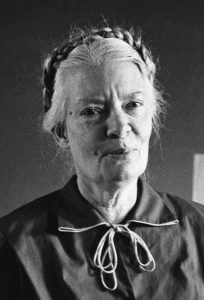
Dorothy Day, the most famous Catholic crusader for social justice in American history, shows us the impact one ordinary person can have on our whole society. She was an unlikely Christian hero, born in Brooklyn in 1897 to nominally Protestant middle class parents who rarely attended church. In 1904, her family moved to Oakland, California where her father took a job as a sportswriter for an area newspaper. In 1906, the great San Francisco earthquake devastated the region, and her father’s job was gone. Nine-year-old Dorothy was profoundly affected by the self-sacrifice and compassion shown by their neighbors to those who had lost everything in the quake.
Despite her parents’ indifference to religion, as a young child Dorothy was drawn to the Bible. Acting on her own at the age of 10, after her family moved to Chicago, she joined the Episcopal Church. In 1916, Dorothy enrolled in the University of Illinois, where she began her journalistic career by submitting pieces to a local paper. Struggling to support herself financially, she was struck by the gap between the lives of the rich and the poor. While maintaining her faith in God, Dorothy came to reject organized religion, believing that churches were doing nothing to alleviate the plight of impoverished people.
Dorothy left college after two years and moved to New York, settling on the Lower East Side of Manhattan. There she got her first paying job as a journalist, covering stories which focused on the disparity between the classes and the failure of the system to alleviate human suffering. In 1917, Dorothy was arrested in Washington D.C. for picketing the White House on behalf of women’s suffrage. She served 15 days of a 45-day sentence, 10 of them on a hunger strike. This experience left Dorothy deeply demoralized, and although she took comfort from Bible psalms, she continued to lose faith in organized religion.
In years that followed, Dorothy’s pursued a bohemian lifestyle, which she later described as dissolute, wasted and full of sensation and sensuality. She had many love affairs through the 1920s, one of which resulted in pregnancy,and an abortion which she called the great tragedy of her life. In 1925, while involved with an activist lover, Dorothy was elated to discover that she was pregnant again, which she had thought to be impossible after the abortion. During this time, Dorothy began an intense exploration of Catholicism (which she saw as the faith of the masses), but her lover wanted no part of either parenthood or religion.
Dorothy’s daughter, Tamar Teresa, was born early in 1926. Soon after, Dorothy encountered Sister of Charity Aloysia Mary Mulhern, who educated Dorothy in the Catholic faith. Tamar was baptized in July 1927, and this marked the end of Dorothy’s relationship with Tamar’s father. With sadness, Dorothy broke with her lover and in December 1927, at the age of 30, she was re-baptized in the Catholic Church.
Catholic Activism
After the stock market crash of 1929, Dorothy was able to support herself as a journalist, writing a gardening column for a New York paper, as well as feature articles and book reviews for Catholic periodicals such as Commonweal. In 1932, Commonweal sent her to Washington D. C. to cover the Hunger March at the capital. Her experience there caused Dorothy to wonder why the Catholic leadership was not gathering people together to perform works of mercy, the technique communists employed so successfully to reach American workers. She went to the National Shrine of the Immaculate Conception to pray that she be shown a way to use her talents to help the workers and the poor.
Dorothy’s prayer was answered that same year when she met Peter Maurin, an immigrant who had been a teacher the Institute of the Brothers of Christian Schools in his native France. Inspired by St. Francis of Assisi, Maurin had a vision of social justice and its link to the poor. He also was well versed in the writings of the Church fathers and papal documents on social issues authored by Pope Leo XIII and his successors. He shared this knowledge with Dorothy, providing her with a greater grounding in Catholic theology to support their mutual quest for social justice.
Maurin favored a program of roundtable discussions of social issues, houses of hospitality to minister to the poor and agricultural universities to foster a return to the land. He proposed to popularize these ideas by publishing a newspaper for the ordinary working person. So it was that on May 1, 1933, in the depths of the Great Depression, the first issue of The Catholic Worker appeared on the streets of New York. Twenty-five hundred copies were printed, selling for one cent apiece (as they do today).
The paper was an immediate success, and circulation reached 100,000 by the end of the first year. Dorothy’s writing focused on conditions of the poor, particularly of workers and the fledgling labor movement. Copies of The Catholic Worker reached parishes and schools throughout the country, spurring donations of food, clothing and money, as well as volunteers to help with the work. People banded together to feed streams of homeless and unemployed, and the first Catholic Worker House of Hospitality was born.
The movement grew as visitors to New York began to form hospitality houses in other cities, and within a few years there were 33 Catholic Worker houses and farms throughout the country. Their work chiefly consisted of publishing the newspaper and helping those who sought assistance at the houses, but some volunteers also participated in street protests, labor strikes and boycotts of businesses with poor working conditions or low wages.
The Cahtolic Worker’s main competitor was the communist publication, The Daily Worker, which Dorothy opposed, especially for its atheism. At its peak, The Catholic Worker’s circulation reached 150,000, but this changed with the outbreak of the Spanish Civil War. Dorothy was an uncompromising pacifist, and this stance caused circulation to fall to 30,000. After a rise in readership after the end of that war, circulation plummeted again when Dorothy maintained her pacifist stance during World War II. Many hospitality houses closed as those who managed them were drafted. Moreover, not all members of the Catholic Worker movement agreed with Dorothy’s pacifist views, which seemed to conflict with the church’s “just war” doctrine.
Nevertheless, Dorothy wrote several books and continued her activism after the end of the world war, chiefly in her opposition to the atomic bomb. She was jailed three times for refusing to participate in civil defense drills in New York. In 1963, Dorothy traveled to Rome in support of Pope John XXIII’s encyclical In Pacem Terris, hoping for an even stronger statement against modern warfare. She returned in 1965 as part of a delegation to the last session of the Second Vatican Council, advocating for Council support of conscientious objection, nonviolence and a ban on nuclear weapons. Dorothy’s positions were largely validated by the Council’s publication of “The Church in the Modern World,”which condemned indiscriminate warfare, supported conscientious objection (with alternate national service), contrasted arms purchases with unmet needs of the poor, and emphasized the nonviolent message of the Gospels.
Dorothy continued her crusading efforts until her death in 1980 at the age of 83. During the civil rights movement she supported justice for minorities and in 1973, at the age of 76, she was jailed for ten days following her arrest at a demonstration against the Teamsters Union by Caesar Chavez and the United Farm Workers. In 1972, the Jesuit magazine America devoted an entire issue to Dorothy and the Catholic Worker movement. The editors lauded her as the person who symbolized the best in both aspiration and action in the American Catholic community during the preceding 40 years.
Today there are roughly 200 Catholic Worker Communities serving people in the United States and abroad. Pope Benedict XVI cited Dorothy Day as an example of how to journey toward faith in a secularized environment, and in an address to the U.S. Congress, Pope Francis recognized Dorothy (together with Abraham Lincoln, Dr. Martin Luther King, Jr. and Thomas Merton) as an important American who built a better future. He stated, “Her social activism, her passion for justice and for the cause of the oppressed, were inspired by the Gospel, her faith and the example of the saints.” Dorothy Day stood for the principle that each of us has the ability and the responsibility to care for the poor and the powerless.